
The AI Revolution in Africa:
Why Kenya is Leading the Future
The AI Revolution refers to the global shift toward using artificial intelligence to automate tasks, enhance decision-making, improve service delivery, and unlock new forms of productivity. In the African context, this revolution is enabling entrepreneurs, creators, governments, and entire industries to do more with fewer resources. For Africa—where innovation often grows out of necessity—AI is not just a trend; it’s a powerful solution to long-standing challenges such as access to healthcare, quality education, reliable financial services, and economic opportunities. Kenya, in particular, is turning AI into a launchpad for digital transformation across the continent.
Why Kenya Is Leading the AI Revolution in Africa
Kenya’s lead in the AI revolution is built on decades of groundwork. The country’s fintech dominance — driven by mobile money services and widespread smartphone penetration — has created a digital-first economy ready for AI-driven change. Over 90% of Kenyan adults own a mobile phone, and mobile money usage (via platforms like M-PESA) now reaches over 90% of the population. Source
At the same time, Kenya has a young, tech-savvy population and a thriving startup culture. A large share of the population is under 35 and increasingly engaged with digital technologies. Source
Finally, the presence of innovation hubs and supportive policies — from coworking spaces and incubators in Nairobi to government digital-economy initiatives — has fostered an environment where AI, fintech, e-commerce, and other digital ventures can grow rapidly. Source
Together, these elements give Kenya unique structural advantages that support its leadership in the broader AI Revolution Africa.
- A Mobile-First Nation
Kenya’s digital landscape is heavily driven by smartphones. Millions of people access the internet primarily through mobile devices, which makes AI tools—especially mobile apps—easy to adopt. This environment accelerates the spread of AI-driven solutions in communication, shopping, finance, customer service, and learning. - M-PESA’s Fintech Ecosystem
Kenya was the first country in the world to embrace mobile money at scale. M-PESA didn’t just change how people transfer money; it created a culture of digital transactions. Today, AI-powered fintech systems easily integrate with M-PESA, enabling:- Smart credit scoring
- Automated loan approvals
- Fraud detection
- Personalized financial services
- A Strong Startup & Innovation Culture
Nairobi—often called “Silicon Savannah”—has emerged as one of Africa’s most important tech hubs. Spaces such as iHub, Nairobi Garage, and Gearbox help innovators build solutions using AI, robotics, IoT, and data analytics. These hubs attract investors and global tech companies that accelerate local growth. - A Young, Digital-Driven Population
Kenya’s youth embrace new technologies quickly. The rising generation of freelancers, creators, developers, and entrepreneurs uses AI for:- content creation
- coding
- freelancing
- business automation
- marketing
- online education
- Government Support for Technology
Kenya’s Digital Economy Blueprint supports AI integration in:- public services
- transport
- education
- healthcare
- national data systems

How AI Is Transforming Business in Kenya and Across Africa
Artificial intelligence is reshaping how businesses operate throughout Kenya and the wider African continent. From small shops in market centres to digital agencies, startups, corporates and government bodies, AI tools are helping organizations cut costs, streamline operations, improve accuracy, and deliver better customer experiences. The transformation is happening faster than many expected, creating new opportunities for growth and innovation.
1. AI in eCommerce
Online shopping in Kenya has grown rapidly, and AI is now pushing the ecosystem into a new phase. Businesses that sell through websites, mobile apps, social media shops, and marketplace platforms are adopting AI to enhance how customers browse and buy.
- Smart product recommendations that show customers exactly what they’re likely to buy.
- Personalized shopping experiences based on browsing behaviour, purchase history, and preferences.
- Automated customer support, including chatbots that answer questions instantly and 24/7.
- Fast and seamless checkout systems that reduce cart abandonment.
- Predictive inventory management, helping businesses restock on time and reduce losses.
For Kenyan SMEs, this means greater efficiency, higher conversion rates, and improved customer satisfaction — whether selling clothes, electronics, groceries, cosmetics, or digital services.
2. AI in Digital Marketing
African businesses are increasingly relying on AI-powered marketing tools to stay competitive in a fast-changing online environment. Whether it’s a new startup or a national brand, AI helps marketers work smarter and produce better results.
- Better content creation, including AI-written posts, captions, blogs, and ad copy.
- Improved audience targeting, ensuring ads reach the right people at the right time.
- Lower advertising costs, achieved through automated bidding and optimized campaigns.
- Automation of repetitive tasks, such as scheduling posts, sending emails, and replying to messages.
- Real-time performance analysis, making it easier to adjust campaigns instantly.
With AI, businesses in Kenya can grow faster without needing large marketing teams — especially on TikTok, Instagram, Facebook, YouTube, and Google Ads.
3. AI in Finance
Kenya is already a global leader in fintech, and AI is strengthening that position. Banks, SACCOs, microfinance institutions, and mobile-money platforms are integrating AI to improve reliability, security, and customer experience.
- Credit scoring and loan assessments, allowing faster and fairer lending decisions.
- Fraud detection, identifying suspicious patterns in real time to protect customers.
- Automated customer messaging, including SMS bots and WhatsApp assistants.
- Financial planning and advisory tools, helping users budget and invest better.
- Market trend analysis, giving investors deeper insights into risk and opportunity.
These improvements build confidence, reduce operational costs, and make financial services more inclusive — especially for unbanked populations.
4. AI in Agriculture
Agriculture remains one of Africa’s strongest economic pillars, employing millions and driving national GDPs. AI is now modernizing the sector by helping farmers make better, data-driven decisions.
- Crop disease detection using smartphone images or drones.
- Reliable weather forecasting, helping farmers plan planting and harvesting.
- Soil testing and analysis that guides fertilizer and seed choices.
- Yield prediction, helping farmers and markets prepare in advance.
- Smart irrigation systems that save water and improve crop health.
Both smallholder farmers and large agribusinesses are using AI tools to increase productivity, reduce losses, and improve food security.
5. AI in Education
Education across Africa is being reshaped by AI-powered learning tools that help teachers and students achieve more with fewer resources.
- Personalized learning, adapting lessons to each student’s pace and level.
- Instant feedback, helping students understand mistakes and learn faster.
- Interactive simulations that make complex topics easier to grasp.
- AI-assisted grading, reducing teachers’ workloads.
- Smart classroom tools, enabling better lesson planning and monitoring.
This is especially valuable in regions with high student populations or limited teaching staff.
6. AI in Healthcare
Healthcare systems across Africa are under pressure — but AI is helping bridge the gap between limited resources and increasing demand for quality care.
- Early diagnosis, using medical imaging, pattern recognition, and symptom analysis.
- Telemedicine services, allowing patients to access doctors remotely.
- Automated medical record management, improving accuracy and organization.
- Drug and equipment stock monitoring, reducing shortages.
- Wearable health devices, tracking heart rate, sleep, glucose, and other vitals.
These solutions make healthcare more affordable, accessible, and efficient — especially in rural areas.
Benefits of the AI Revolution Africa for Businesses
The AI Revolution Africa is not just a buzzword — it delivers tangible benefits for companies of all sizes. Businesses that adopt AI can optimize operations, reduce costs, and unlock new growth opportunities. Here’s a detailed look at how AI helps businesses thrive:
| Business Goal | AI Advantage | Examples |
|---|---|---|
| Reduce Costs | Automates repetitive tasks, cutting labor hours and errors | ChatGPT for content or customer messages, Zapier for workflow automation |
| Increase Sales | Enables personalized product and service recommendations, boosting conversions | Meta AI Ads for targeted campaigns, Shopify AI for eCommerce personalization |
| Improve Efficiency | Speeds up workflows, reduces bottlenecks, and automates scheduling | Make.com for automation, AI scheduling assistants |
| Better Decisions | Provides data-driven insights for smarter strategy | Power BI dashboards, Google AI analytics |
| Customer Support | Offers 24/7 assistance, instant responses, and multilingual support | Intercom chatbots, Botpress conversational AI |
The result is a stronger, smarter, and more competitive business environment. Companies that integrate AI see measurable improvements in revenue, operational speed, and customer satisfaction. Even small businesses can leverage AI to level the playing field with larger competitors.
To deepen your knowledge, explore more insights on:
How Kenyan Businesses Can Start Using AI Today
Adopting AI doesn’t require a massive budget or a dedicated technical team. Even micro-businesses can take meaningful steps toward AI-powered growth.
Step-by-Step Guide to AI Adoption
- Identify repetitive or time-consuming tasks
Examples: emails, social media posts, reports, inventory updates, or customer queries. - Choose the right AI tools for your goals
Focus on software that aligns with your business needs — chatbots for support, analytics tools for decision-making, or AI platforms for marketing automation. - Train your staff on AI basics
Provide simple tutorials or workshops to help your team understand how AI works and how to use it effectively. - Start small
Begin with one or two processes. For instance, automate your email follow-ups or social media posting before moving to more complex tasks. - Measure results and scale gradually
Track KPIs such as response times, sales growth, or workflow efficiency. Expand AI applications based on measurable success.
By taking small, strategic steps, businesses of any size can gradually transform operations and achieve tangible results without overextending resources.
Best Practices for Thriving in the AI Era
- Focus on customer needs first — identify pain points and use AI to solve real problems rather than implementing tech for the sake of it.
- Use AI to complement human teams — AI can automate repetitive tasks, but human creativity, decision-making, and cultural understanding remain essential.
- Keep updating your skills — AI tools evolve rapidly. Encourage staff to stay informed and learn new AI applications relevant to your industry.
- Pick tools that integrate with existing systems — seamless integration avoids disruption and ensures smoother workflows.
- Start with easy-to-implement automation — early wins motivate teams and provide proof of concept before larger investments.
- Review performance regularly — monthly metrics help businesses track improvements and identify areas for further AI adoption.

Challenges Slowing Down AI Adoption in Africa
- Limited AI Skills — many organizations struggle to find staff trained in AI or data analytics. Bridging this skills gap requires training programs and education initiatives.
- Poor Data Infrastructure — AI depends on high-quality data. In many African industries, data is fragmented or unstructured, making it harder to develop reliable AI solutions.
- High Internet Costs — stable internet connectivity is essential for cloud-based AI tools. In regions with expensive or slow connections, adoption can be limited.
- Infrastructure Limitations — access to reliable devices, electricity, and cloud computing services remains uneven, restricting scalability.
Despite these hurdles, Kenya is moving faster than most African countries. With a strong tech ecosystem, supportive government policies, and innovation-friendly startups, the country is overcoming barriers and leading the AI revolution on the continent.
Real Examples of AI Transformations in Kenya
Many Kenyan firms — from agritech startups to fintech platforms — are already using AI in ways that illustrate the concrete benefits we described earlier. Here are several real-world examples:
AI for Agriculture & Food Supply
- Apollo Agriculture uses AI, satellite imagery, and ML models to support farmers. Source
- Twiga Foods leverages AI-driven demand forecasting and supply-chain optimization. Source
- Farmers using AI agritech tools report increased yields. Source
AI in Finance & Fintech
- Tala and other fintech lenders use AI-based credit scoring. Source
- AI improves fraud detection and secure transactions.
- Survey shows 96% of Kenyan organizations use AI. Source
AI for MSMEs & Small Businesses
- Fastagger provides an AI-powered business intelligence assistant. Source
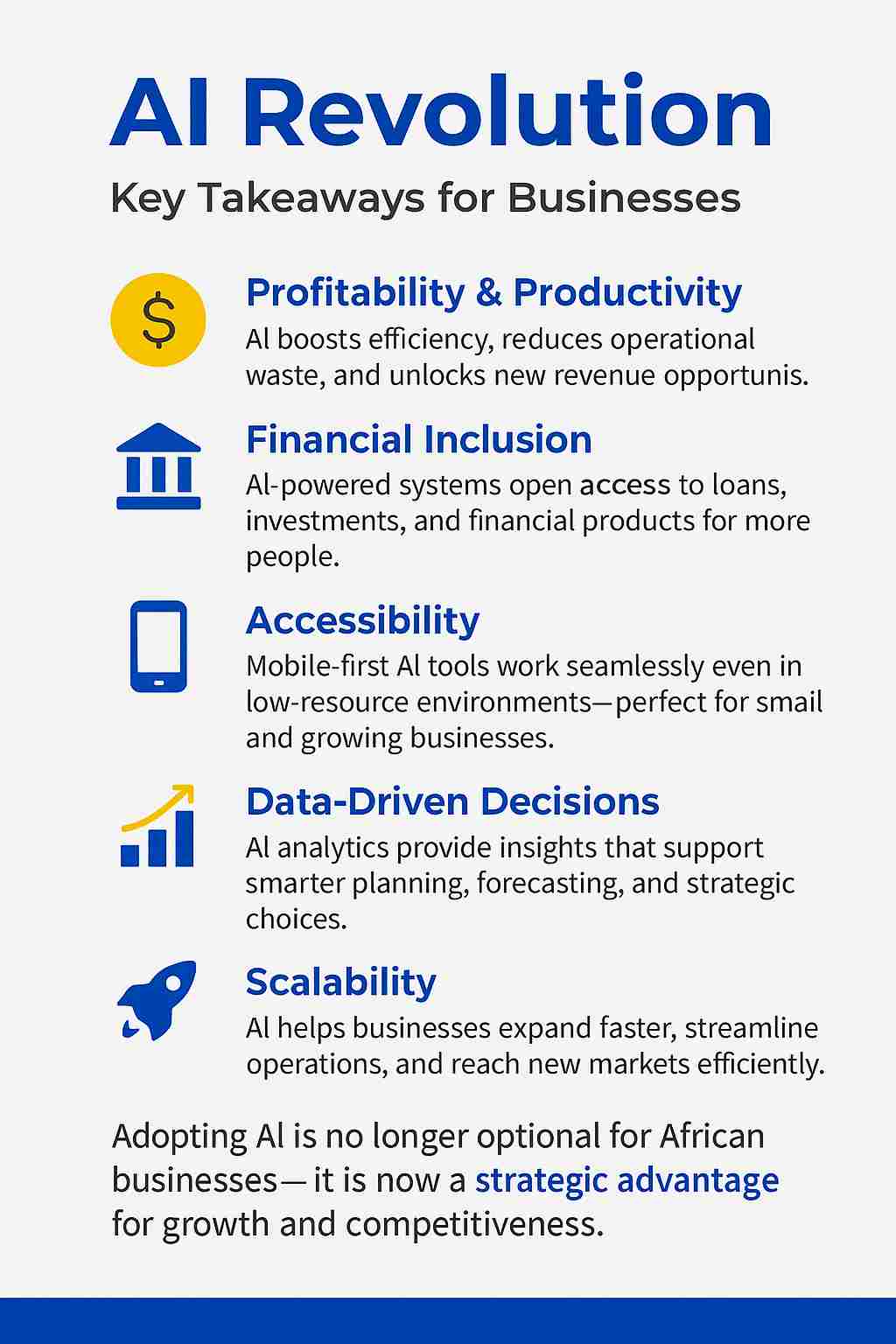
Key Takeaways for Businesses
- Profitability & Productivity: AI helps increase efficiency, reduce waste, and improve revenue streams.
- Financial Inclusion: AI-driven tools allow broader access to loans, financial products, and investment opportunities.
- Accessibility: Mobile-first AI tools work even in low-resource settings, enabling small businesses to participate.
- Data-Driven Decisions: AI analytics empower smarter business planning and strategy adjustments.
- Scalability: AI allows businesses to expand reach, streamline operations, and serve new markets efficiently.
These examples make it clear: embracing AI is no longer optional for African businesses — it’s a strategic advantage.
Explore More From Pro Chris
My Profile
Learn more about who I am, what I do, and the impact I’m committed to creating across Africa.
My Portfolio
Browse projects I’ve delivered, digital systems I’ve built, and real-world solutions I’ve helped organizations implement.
My Trainings
Explore my professional training programs designed for youth, startups, SMEs, institutions, and digital transformation initiatives.
The Future of the AI Revolution Africa (2026–2030)
- Smart Cities Powered by AI
African cities are beginning to integrate AI into urban planning, energy management, and public services. Smart sensors, predictive analytics, and AI-driven infrastructure will improve traffic flow, energy efficiency, waste management, and citizen engagement, creating more livable, sustainable cities. - Automated Public Transport
AI-enabled transport systems will optimize bus routes, ride-hailing services, and freight logistics, reducing congestion and travel times. Autonomous shuttles and predictive maintenance technologies are likely to appear first in tech-forward cities like Nairobi and Kigali. - Intelligent Traffic Management
AI-powered traffic lights and predictive traffic systems will reduce congestion and accidents, optimize signal timing, and integrate with public transport apps. These systems will save time, fuel, and reduce carbon emissions in rapidly growing urban areas. - AI-Powered Education
Schools will increasingly use AI tutors and learning platforms that personalize lessons, monitor student progress, and recommend individualized study paths. Teachers will also benefit from AI-assisted grading and curriculum planning, enhancing educational outcomes across Africa. - Enhanced Cybersecurity
As more businesses and governments digitize, AI-driven cybersecurity solutions will become critical. Machine-learning algorithms will detect anomalies, prevent fraud, and predict cyber threats, helping protect sensitive data and online transactions. - AI-Driven Manufacturing
Industries will adopt AI to streamline production, reduce defects, forecast demand, and manage supply chains efficiently. Robotics and predictive maintenance will enhance manufacturing capacity, making African factories more competitive globally. - Continent-Wide Digital Identity Systems
AI will play a central role in secure digital identification, enabling governments and financial institutions to provide services efficiently. From banking and healthcare to voting systems, AI-powered identity verification will help ensure trust and inclusion.
Kenya’s Central Role in Africa’s AI Future
Kenya’s established tech ecosystem, fintech leadership, and innovation-friendly policies make it a central driver of these future developments. Nairobi, often called the “Silicon Savannah,” will likely host AI research hubs, innovation labs, and pilot smart city projects, setting a blueprint for other African nations. As AI becomes embedded in daily life, businesses, governments, and citizens across Africa will experience faster, smarter, and more connected systems, paving the way for economic growth, improved public services, and a new era of digital innovation.
Conclusion
The AI Revolution Africa is already transforming how people work, learn, shop, farm, and build businesses. Kenya is not just participating in this revolution—it is leading it. With its vibrant startup ecosystem, innovative fintech culture, strong youth population, and government support, Kenya is well-positioned to shape Africa’s digital future. For professionals and businesses, the message is clear: embracing AI today is the key to staying relevant tomorrow.
FAQs
Answer
AI helps automate content creation, optimize ads, enhance targeting, and improve campaign performance—reducing costs while increasing results.
Answer
Google Search, Facebook Ads, TikTok, WhatsApp marketing, SEO, and influencer campaigns provide strong returns for businesses.
Answer
Budgets typically range from KSh 300 to 3,000 per day, depending on the industry and competition.
Answer
SEO, short-form video content, WhatsApp broadcasts, influencers, paid ads, and AI-powered remarketing strategies.
Answer
Shopify, WooCommerce, Flutterwave Store, and Jumia Marketplace are popular and effective.
Answer
Use plugins for Shopify or WooCommerce or integrate using Safaricom’s Daraja API.
Answer
AI will not replace marketers—but marketers who refuse to use AI will fall behind. Human creativity and strategy remain essential.
Answer
Yes. Thousands of Africans earn through online stores, dropshipping, digital products, and social commerce.
Answer
ProChris offers professional AI & eCommerce training for accredited institutions. Explore programs that fit your goals here: here.

Pro Chris is a certified digital strategist, tech mentor and trainer, and full-stack developer empowering youth, startups, and businesses in Africa through practical insights on digital marketing, automation, and digital transformation
Want to Learn More About Pro Chris?
Explore his work, trainings, events, and connect directly for mentorship, consultation or partnership.

Very innovative
Kenya is leading in future
So visionary. Kenya is the centre and so embracing the AI development is key to the benefits stated herein. Good piece @Pro Chris
Thank you so much, Onyango Reinhard! 🙏
I truly appreciate your encouragement. Kenya has a massive opportunity in AI, and I’m glad we’re aligned on the vision. Let’s keep pushing the conversation forward.